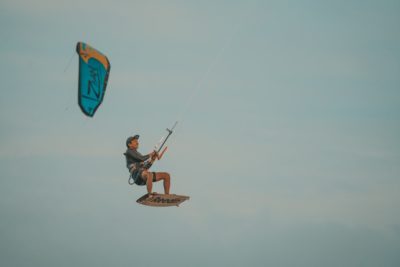
Windsurf board, equipment, and Supplies

Windsurfing has always been a child of the surfing tradition. It even features the word in its name! The similarities between the two sports are vivid and numerous. Both are water sports. They both use a board. They both are powered without the use of an engine. And both sports are popular in beach culture.
Similarly to biking and mountain biking however, there are many differences, as adherents to each sport would be the first to tell you. Purists from both camps engage in good natured disparaging of the opposing sport. The windsurfers require more equipment than a regular surfer does, but they are also more versatile on the water. Surfers can grab a board, a tether, and go ride the waves… but all they can do is go where the current takes them.
A windsurfer by contrast has much more equipment to worry about. They need to have a sail, which must then be properly trimmed. They need a mast, and a boom to do that. The windsurfing sails are a take on the eastern racing sail. They feature two tensioning points, there’s the downward tension applied via a pulley system at the base of the sail on the mast. And there is the lateral tension that is applied via a grommet placed at the tip of the boom. To properly tension these things, you will also need some high quality, albeit small, ropes.
The mast and boom on a windsurfing rig are different from those on many sailing craft. For starters, the mast on a windsurfing board is attached to the board via a universal joint. The u-joint allows a full hemisphere of movement to be undertaken by the mast. This means you can lay the mast completely flat on the water, hold it straight upright, or at any angle in between. You can also rotate it three hundred and sixty degrees at any position along that arc.
The boom on a windsurfing sail is a wishbone style boom. As the name implies, a wishbone boom is two pronged. It originates at the mast in a clamp attachment, and snakes both forks out in the same direction, they meet with a small space between them at the tips, just like the wishbone on a thanksgiving turkey… you know, if thanksgiving turkey was made out of carbon fiber or impact resistant aluminum. This allows the sail to be controlled from either side, which is vital considering that it has a full range of movement and may need to be positioned to either side of a windsurfer’s body.
Now that you have a sail, mast, and boom, what’s left? Well the board, of course. A windsurfing board features the u-joint itself at mid mass. It is shaped much like a regular surf board, but recent changes in the sport have led to some differences between the two. For instance, you can place up to five fins at the rear of a windsurfing board, and for the best control in challenging conditions; many expert windsurfers do just that.
In addition to the board itself, you’ll want a means of securing yourself to the board. Unlike surfing, this isn’t done via a foot tether. A harness that fits around a rider’s thighs, the buttocks, or the lower back is usually used to secure you- not to the board, but to the mast. This is done so that your arms don’t have to support your body weight in addition to maneuvering the sail. This greatly reduces the fatigue on your arms, and makes a longer ride possible.
Dont forget your surf wear! It is important as quality boards and equipment.